Blog
BTK Inhibitors in CLL Treatment: How Targeted Treatment Is Changing Care
Samar Elkassas
May 18, 2026
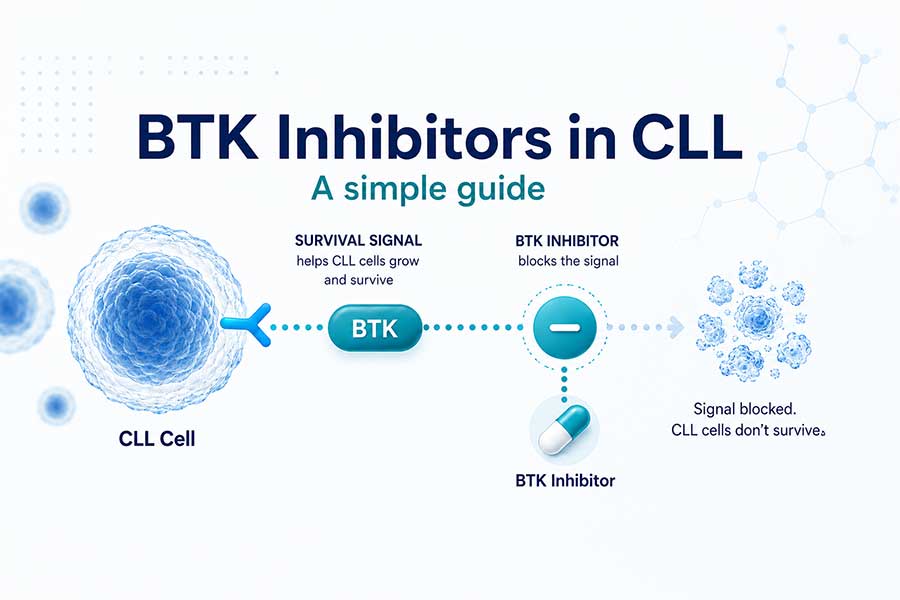
BTK inhibitors have changed how chronic lymphocytic leukemia, or CLL, is treated. Instead of using traditional chemotherapy for many patients, doctors can now use targeted oral medicines that block signals CLL cells need to survive. But not every patient needs treatment right away, and not every BTK inhibitor is the same. Understanding how these treatments work can help patients and clinicians make more personalized treatment decisions.
What are BTK inhibitors?
BTK (Bruton's Tyrosine Kinase) is a protein inside CLL cells that acts like a survival signal. It tells leukemia cells to keep growing and avoid dying. When you block BTK, you essentially cut off this survival switch — and the leukemia cells can no longer thrive.
Think of it this way: if CLL cells are plants, BTK is the water supply. BTK inhibitors turn off the tap.
How Do BTK Inhibitors Work in CLL?
BTK inhibitors are usually taken by mouth as tablets or capsules. They do not work like classic chemotherapy. Instead of broadly attacking fast-growing cells, they target a key pathway that CLL cells depend on.
Which BTK inhibitors are used in CLL?
Several BTK inhibitors are used in CLL treatment:
Ibrutinib (Covalent BTKi)
Ibrutinib was the first BTK inhibitor widely used in CLL and helped change the treatment landscape.
Acalabrutinib and zanubrutinib (Covalent BTKi)
Newer covalent BTK inhibitors. They are often preferred in many settings because they are effective and tend to have fewer certain heart-related side effects compared with ibrutinib, especially atrial fibrillation.
Pirtobrutinib (Non-Covalent BTKi)
Pirtobrutinib is a newer Non-covalent BTK inhibitor. It works differently from ibrutinib, acalabrutinib, and zanubrutinib, and is approved for adults with relapsed or refractory CLL/SLL who have previously received a covalent BTK inhibitor.
When are BTK inhibitors used?
BTK inhibitors may be used as a first treatment for CLL or after previous therapy, depending on the patient’s disease features, prior treatments, other health conditions, and treatment goals. The NCI PDQ summary lists ibrutinib, acalabrutinib, and zanubrutinib among established first-line options for previously untreated CLL.
They are especially important for patients with higher-risk disease biology, such as TP53 mutation or del(17p), where older chemoimmunotherapy approaches are usually less effective. Modern targeted treatments, including BTK inhibitors and venetoclax-based regimens, have helped make CLL treatment more personalized.
Who Needs CLL Treatment & When Should Treatment Start?
Not every CLL patient needs to start treatment immediately. Many are monitored with a "watch and wait" strategy for months to years. Treatment is typically initiated when:
Significant lymph node enlargement
Worsening anemia or low platelet counts
Constitutional symptoms (drenching night sweats, significant weight loss, fatigue)
Rapid lymphocyte doubling time
When treatment is needed, BTK inhibitors are now first-line for the vast majority of patients, including those with high-risk features like del(17p) or TP53 mutations — situations where chemotherapy often fails.
Continuous vs Fixed-Duration combined BTK Inhibitor Treatment
Many BTK inhibitors are taken continuously until the disease progresses or side effects become unacceptable. However, CLL treatment is evolving, and some newer combinations are designed to be time-limited.
One of the most exciting recent developments is combining BTK inhibitors with venetoclax (a BCL-2 inhibitor), creating an all-oral, chemotherapy-free doublet.
The AMPLIFY trial (phase III, published in NEJM, 2025) evaluated acalabrutinib + venetoclax (with or without obinutuzumab) versus standard chemoimmunotherapy in previously untreated CLL patients. The results showed deep and durable responses in favor of the targeted combination , with acalabrutinib regimens also showing notably lower rates of febrile neutropenia compared to chemotherapy. Cardiac events, including atrial fibrillation, remained infrequent (0.7–2%).
On February 19, 2026., the FDA approved acalabrutinib plus venetoclax as an all-oral, fixed-duration treatment option for adults with CLL/SLL, marking an important step toward chemotherapy-free, time-limited therapy.
Possible side effects of BTK Inhibitors
While BTK inhibitors are far more tolerable than chemotherapy, patients and clinicians should still monitor for:
Bruising or bleeding: Mild bruising is common. Patients should tell their care team if they are taking blood thinners or planning surgery.
Atrial fibrillation: An irregular heart rhythm can occur, especially with ibrutinib. This risk appears lower with newer BTK inhibitors such as acalabrutinib and zanubrutinib.
High blood pressure: Blood pressure may increase during treatment and should be checked regularly.
Joint or muscle aches: Some patients experience aches or stiffness, which often improve over time.
Fatigue, diarrhea, or rash: These are usually mild, especially early in treatment, and may settle with time.
Infections: BTK inhibitors can affect immune function, so patients should report fever, persistent cough, or other signs of infection.
Most side effects are manageable and improve with time or dose adjustment. Rarely, late complications like dyskinesias or severe bleeding may require discontinuation.
What happens if a BTK inhibitor stops working?
If CLL progresses while on a BTK inhibitor, the next treatment depends on what the patient has already received. Options may include a venetoclax-based regimen, a different targeted therapy, pirtobrutinib after prior covalent BTK inhibitor exposure, or a clinical trial. On December 3, 2025., the FDA granted traditional approval to pirtobrutinib for relapsed or refractory CLL/SLL after prior covalent BTK inhibitor treatment, based on improved progression-free survival compared with investigator’s choice therapy in BRUIN-CLL-321.
Why clinical trial matching matters?
CLL Clinical trials are increasingly specific. A trial may require a certain prior therapy, BTK inhibitor exposure, BTK inhibitor intolerance, BTK inhibitor refractory disease, TP53 mutation, del(17p), IGHV status, MRD status, or a specific number of prior lines of therapy. This means two patients with CLL may have very different trial options even if they share the same diagnosis.
Key takeaway
BTK inhibitors are targeted oral treatments that block survival signals CLL cells need to grow.
They are now a major treatment option for many patients with CLL, including those with high-risk features such as TP53 mutation or del(17p).
Different BTK inhibitors may be used in different situations, including first-line treatment, relapsed disease, or after prior BTK inhibitor therapy.
Side effects are usually manageable, but monitoring for bleeding, infections, blood pressure changes, and heart rhythm issues is important.
CLL treatment is becoming more personalized, with newer combinations and clinical trials helping match patients to the most suitable therapy.



Blog