Blog
In Vivo CAR-T Therapy in Multiple Myeloma: Where It Fits in the Evolving Landscape of T-Cell Therapies for Multiple Myeloma
Samar Elkassas
Jan 12, 2026
Over the past few years, multiple myeloma treatment has entered an era of immune engineering. Bispecific antibodies, trispecific antibodies, and CAR-T cell therapies are all built around the same core idea: redirecting T cells to recognize and kill myeloma cells more effectively.
Each approach solves part of the problem — and introduces new challenges.
In vivo CAR-T therapy represents the next step in this evolution.
Where In Vivo CAR-T Fits Among Emerging Modalities
Today’s immune-based strategies differ mainly in how T cells are engaged:
Bispecific antibodies bring existing T cells into contact with tumor cells
Trispecific antibodies improve targeting precision and reduce antigen escape
Ex vivo CAR-T permanently reprograms T cells, but requires complex manufacturing
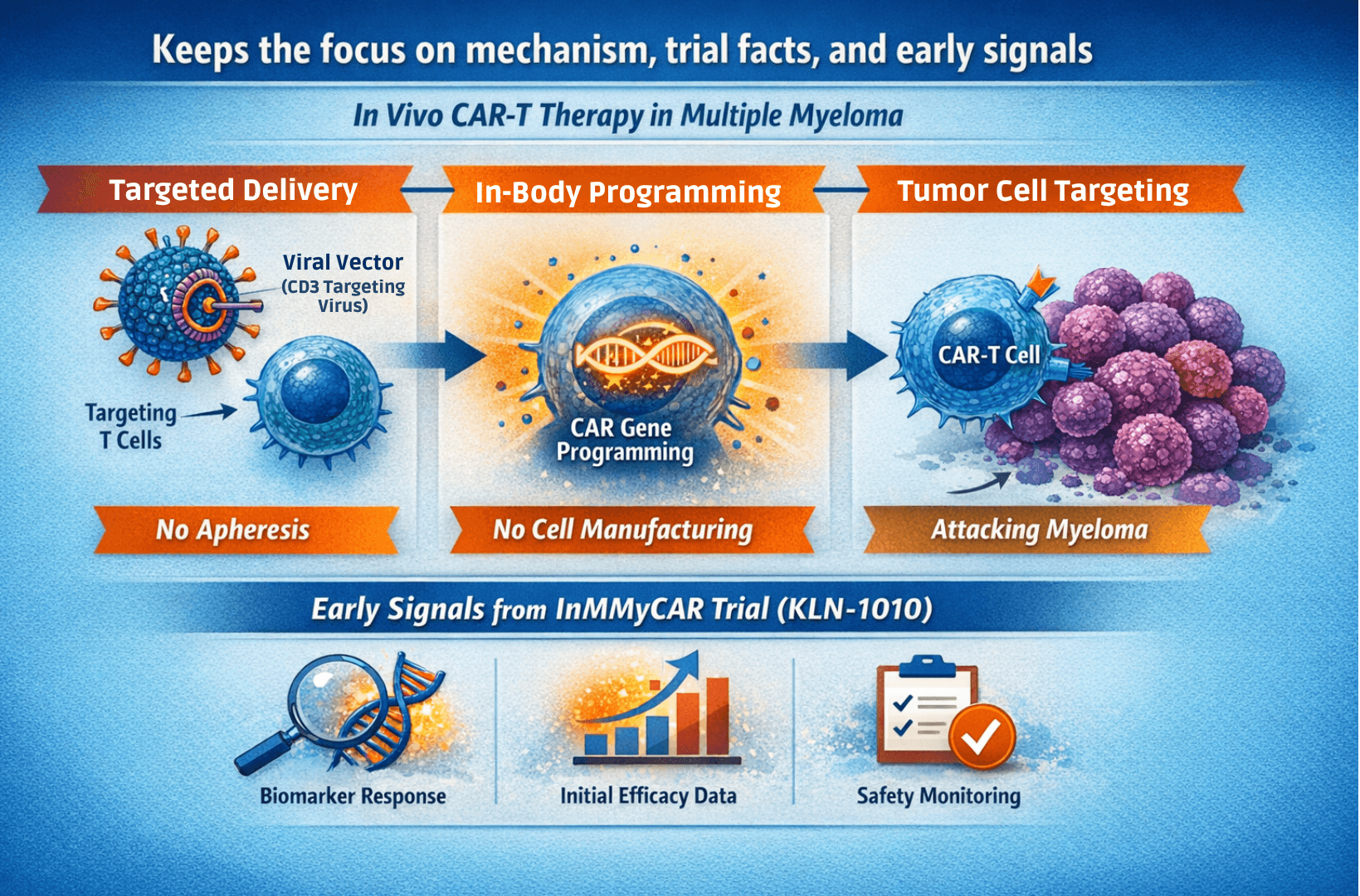
In vivo CAR-T therapy takes a different approach. Instead of engineering T cells outside the body, it programs them directly inside the patient using gene therapy. This strategy could significantly simplify how CAR-T–like treatments are delivered.
The goal is to combine:
The depth of response seen with CAR-T
The speed and scalability of off-the-shelf therapies
Modality | How T cells are engaged | Key Advantages | Limitations |
Bispecific antibodies | Redirect existing T cells to tumor cells. | Off-the-shelf, immediate availability | T-cell exhaustion, Repeated dosing |
Trispecific antibodies | Engage T cells and improve targeting. | Off-the-shelf, immediate availability | Early clinical data, complex biology, |
Ex vivo CAR-T | Patient T cells are collected, engineered outside the body, then reinfused | Deep and durable responses | Manufacturing delays (apheresis + centralized manufacturing), lymphodepletion required, limited access, |
In vivo CAR-T (KLN-1010) | Genetic programming occurs directly in patient T cells, converting T cells into CAR-T inside the patient | Combines CAR-T depth with faster access, off-the-shelf delivery. | Experimental, long-term durability still unknown |
One investigational therapy using this approach is KLN-1010, currently being studied in the inMMyCAR trial (NCT07075185).
What Is KLN-1010?
KLN-1010 is an investigational in vivo gene therapy designed to generate anti-BCMA CAR-T cells inside the patient’s body after a single infusion.
Unlike traditional CAR-T:
No apheresis is required
No ex vivo cell manufacturing is needed
No lymphodepleting chemotherapy is required
The goal is to produce functional CAR-T cells directly in the bloodstream, using the patient’s own immune system as the manufacturing site.
How In Vivo CAR-T Therapy Works
KLN-1010 uses a process called selective transduction to modify T cells:
1. Targeted viral delivery
The therapy is delivered using a modified vesicular stomatitis virus. The virus is engineered with a CD3-targeting component, which allows it to selectively enter T cells.
2. In vivo Genetic programming
Once inside the T cell, the virus delivers genetic instructions that cause the cell to express a BCMA-directed chimeric antigen receptor (CAR).
3. Tumor recognition and killing
The newly engineered CAR-T cells recognize BCMA, a protein highly expressed on multiple myeloma cells, and begin targeting and killing those cells.
This entire process happens inside the patient, following a single infusion.
No apheresis. No ex vivo manufacturing. No lymphodepleting chemotherapy.
The inMMyCAR Trial: Early Clinical Data
The inMMyCAR study is a Phase 1, first-in-human, dose-escalation clinical trial evaluating the safety and early activity of KLN-1010 in patients with relapsed or refractory multiple myeloma.
Very early results are available for three patients:
Ages 61–72
High-risk cytogenetics
3–4 prior lines of therapy
No prior exposure to BCMA-directed treatments
What Was Observed?
All three patients achieved minimal residual disease (MRD) negativity one month after treatment
One patient remained MRD-negative at three months
All patients had partial responses that deepened over time
No disease progression was reported at the time of analysis
MRD negativity is a sensitive marker of treatment activity in myeloma, but at this early stage it should be interpreted as a biological signal, not proof of long-term benefit.
Safety Observations So Far
All patients experienced treatment-related side effects, which is expected for immune-based therapies:
Infusion-related reactions occurred in 2 of 3 patients and resolved within 48 hours
Two patients developed grade 2 cytokine release syndrome (CRS)
One patient had transient neutropenia
One patient had transient anemia
No severe CRS, no neurotoxicity, and no infection-related adverse events were reported after one month of follow-up. However, the patient number is very small, and safety conclusions remain preliminary.
Why This Matters
If future studies confirm safety and durability, in vivo CAR-T therapy could address key limitations of current CAR-T approaches:
Faster access to treatment
Reduced logistical complexity
Broader availability beyond specialized centers
At the same time, important questions remain, including how durable these responses are and how well CAR-T activity can be controlled over time.
Trial Access and Precision Matching
KLN-1010 is currently available only through the inMMyCAR clinical trial. Eligibility depends on prior treatments, disease status, and safety criteria specific to gene therapy studies.
Trials like this are difficult to identify using traditional search tools because they combine gene therapy, cellular immunotherapy, and targeted myeloma biology. CancerBot tracks and structures these emerging trial designs to help patients and clinicians identify options that match both disease biology and treatment history.
Bottom Line
In vivo CAR-T therapy represents a new way of delivering CAR-T–like treatment without apheresis, manufacturing delays, or lymphodepleting chemotherapy. Early results from the inMMyCAR trial show that this approach can generate active, BCMA-targeted CAR-T cells inside the body and achieve MRD negativity in heavily pretreated patients.
These findings are early and exploratory, but they mark an important step toward potentially simpler and more accessible cellular therapies for multiple myeloma.



Blog